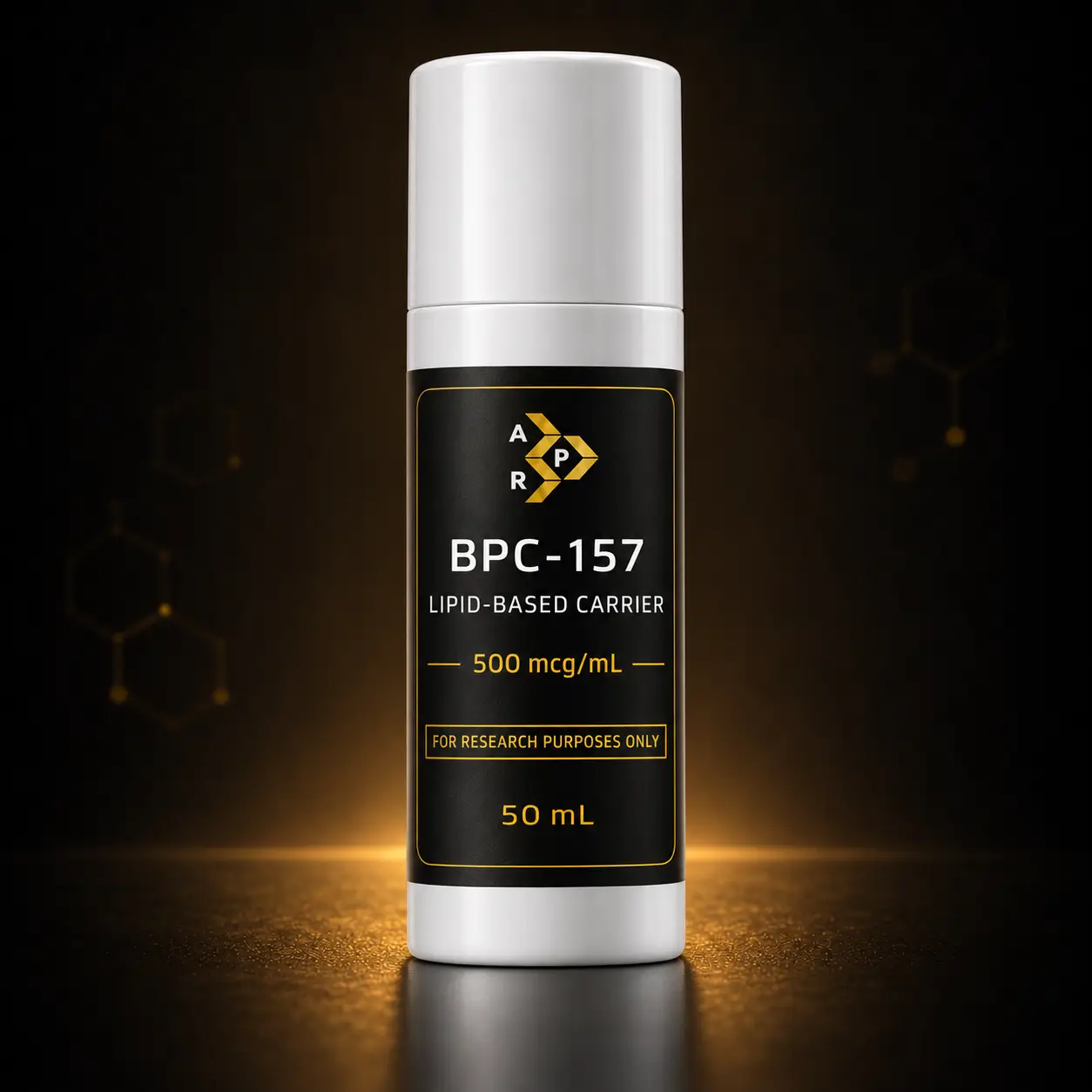
Pentadecapeptide (BPC-157) is contained in specialized lipid-based carrier designed to facilitate the investigation of BPC-157 permeation dynamics, tissue interaction, and stability across synthetic membrane and epidermal and dermal models. Developed strictly for preclinical laboratory protocols and in vitro/ex vivo testing, this preparation enables precise quantification of peptide transdermal flux, cellular signaling pathways, and localized angiogenic activity without degradation in controlled experimental setups. This analytical formulation contains the 15-amino-acid stable gastric pentadecapeptide (
Gly-Glu-Pro-Pro-Pro-Gly-Lys-Pro-Ala-Asp-Asp-Ala-Gly-Leu-Val) embedded within an advanced lipid-based carrier. While conventional peptide research relies on aqueous system kinetics, peptide gel modeling evaluates the transport of intact macromolecular compounds across the hydrophobic lipid bilayers of the stratum corneum. Once translocated across the cutaneous barrier, research suggests that the pentadecapeptide initiates architectural repair by activating vascular endothelial growth factor receptor 2 (VEGFR2), upregulating the focal adhesion kinase (FAK)/paxillin pathway in fibroblasts, and balancing local nitric oxide (NO) generation.
What are the Mechanisms of Action?
The biochemical pathways and localized cellular targets of Pentadecapeptide BPC-157 in laboratory research include:
- Stratum Corneum Translocation: The carrier matrix temporarily fluidizes intercellular lipid domains within the stratum corneum. Research suggest that this allows organic molecules to bypass transcellular resistance, partitioning directly into dermis, fascial layers, and localized myotendinous junctions without undergoing hepatic first-pass extraction.
- VEGFR2 Activation & Microvascular Angiogenesis: Research suggests that pentadecapeptide upregulates vascular endothelial growth factor receptor 2 (VEGFR2) transcription and promotes receptor internal activation, driving rapid endothelial cell sprouting, collateral microvascular formation, and localized tissue perfusion.
- FAK/Paxillin Pathway & Tenocyte Migration:In localized tenocytes and fibroblasts, pentadecapeptide stimulates the phosphorylation of focal adhesion kinase (FAK) and paxillin. This activates the cytoskeletal machinery required for directed cell migration toward injured matrix zones and stimulates organized type I collagen bundle deposition.
- Nitric Oxide System Balancing & Cytoprotection: pentadecapeptide modulates both constitutive endothelial nitric oxide synthase (eNOS) and inducible nitric oxide synthase (iNOS), maintaining microvascular homeostasis and suppressing localized oxidative cell apoptosis and pyroptosis in stressed connective tissues.
What do Preclinical & Academic Studies Show for pentadecapeptide?
When evaluating published scientific literature for pentadecapeptide:
- Tendon Outgrowth & Fibroblast Signaling (PubMed): Landmark biology studies cataloged on PubMed (PMID: 21030672)confirm that it accelerates explant tendon outgrowth, enhances cell survival under oxidative stress, and upregulates growth hormone receptor expression in tendon fibroblast assays.
- Angiogenesis & Granulation Tissue Induction (PMC): Comprehensive reviews archived in PMC (PMC6271067) document it’s capacity to induce early growth response gene 1 (egr-1), stimulate VEGFR2-mediated vascular network expansion, and promote dermal collagen matrix reorganization.
- Chemical Profiling & Molecular Identity (PubChem): Official structural characterization maintained on PubChemverifies the molecular mass (1419.53 g/mol), pentadecapeptide sequence, and HPLC mass spectrometry profile of CAS 137525-51-0.
How does Pentadecapeptide Gel compare to other formulations and compounds?
To evaluate delivery kinetics, tissue localization, and target specificity, researchers compare Pentadecapeptide against alternative reference standards:
BPC-157 (Lipid-based Carrier) vs. Lyophilized Pentadecapeptide
In cellular and animal tissue research, route of administration dictates tissue concentrations and pharmacokinetic distribution:
- Pentadecapeptide BPC-157 (Lipid-based Carrier): Delivers high, localized peptide concentrations directly to superficial and intermediate connective tissue beds, joint capsules, and dermal-fascial layers. Bypasses systemic clearance and delivers high localized payload directly to the application site.
- Lyophilized / Systemic Pentadecapeptide:Undergoes rapid systemic distribution via bloodstream circulation. Highly effective for generalized gastrointestinal, systemic vascular, and multi-organ research models, but yields lower localized tissue concentration at specific peripheral joints or superficial tendons compared to direct transdermal application.
What do Preclinical & Academic Studies Show for pentadecapeptide?
When evaluating published scientific literature for pentadecapeptide:
- Tendon Outgrowth & Fibroblast Signaling (PubMed): Landmark biology studies cataloged on PubMed (PMID: 21030672)confirm that it accelerates explant tendon outgrowth, enhances cell survival under oxidative stress, and upregulates growth hormone receptor expression in tendon fibroblast assays.
- Angiogenesis & Granulation Tissue Induction (PMC): Comprehensive reviews archived in PMC (PMC6271067) document it’s capacity to induce early growth response gene 1 (egr-1), stimulate VEGFR2-mediated vascular network expansion, and promote dermal collagen matrix reorganization.
- Chemical Profiling & Molecular Identity (PubChem): Official structural characterization maintained on PubChemverifies the molecular mass (1419.53 g/mol), pentadecapeptide sequence, and HPLC mass spectrometry profile of CAS 137525-51-0.
All research peptide products are packed with care to help protect product integrity during transit. Orders are processed promptly once payment has been confirmed, with dispatch times depending on stock availability and order volume.
Peptides may be shipped using temperature-conscious packaging where appropriate. On arrival, please check the parcel immediately and follow the storage instructions shown on the product label or accompanying documentation.
Estimated delivery times vary by location and courier service. Tracking details will be provided once your order has been dispatched. Please ensure someone is available to receive the parcel, as delays after delivery may affect product condition.
For any questions about delivery, packaging, or storage requirements, please contact our team before placing your order.